
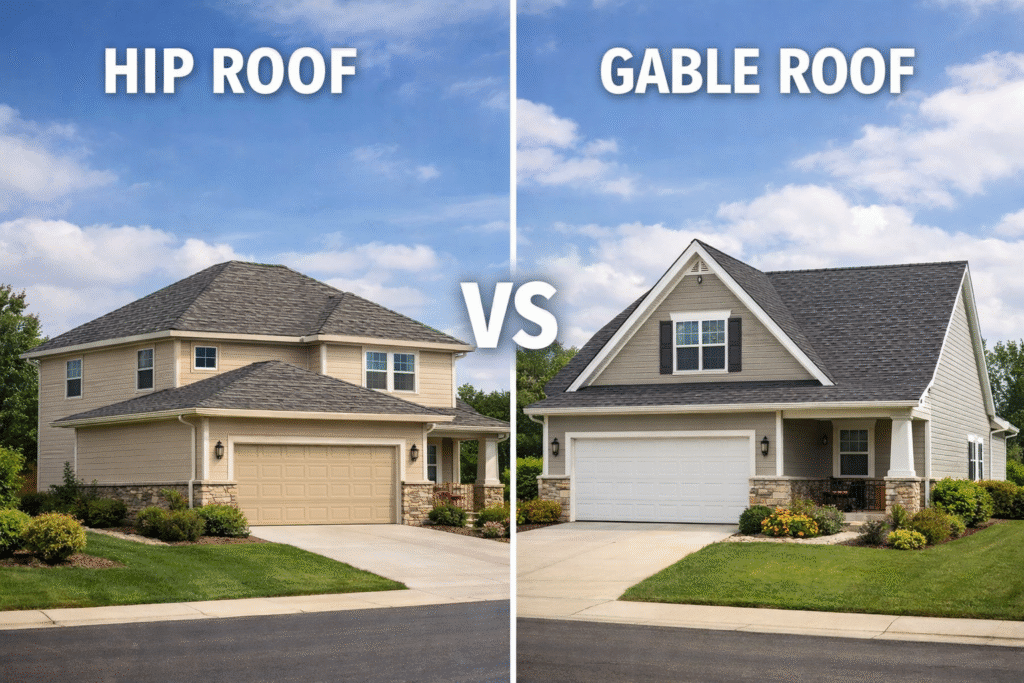
Choosing the right roof design for your home is one of the most important decisions you’ll make during construction or a reroofing project. Two of the most popular options homeowners consider are the hip roof vs gable roof but what exactly makes them different and which one is best for your needs? In this complete guide we’ll explain their definitions, structural differences, cost implications, weather performance, typical use cases, advantages and disadvantages, and more to help you make an informed choice.
What Is a Gable Roof (Definition & Meaning)
A gable roof is one of the most recognizable roof shapes because of its simple, triangular form. It consists of two sloping sides that meet at a horizontal ridge, with vertical walls at each end forming the familiar “A‑shaped” gable.
- The vertical triangular section of wall beneath the roof’s two slopes is called the gable itself, often referred to as a gable end.
- Gable roofs are common in many architectural styles and climates where efficient water and snow shedding is important.
This design is straightforward, cost‑effective, and provides excellent attic space and ventilation compared to more complex roof forms.
What Is a Hip Roof (Definition & Meaning)
By contrast, a hip roof (or hipped roof) features slopes on all four sides that converge toward a central ridge or peak. There are no vertical gable ends on a hip roof — all faces slope downward toward the walls.
- The external angle where two roof slopes meet is called the hip, and these add structural bracing to the roof.
- Because all sides slope inward, hip roofs are typically more stable and resistant to wind uplift.
This style is common in areas with high wind loads and severe weather because its geometry distributes forces more evenly across the roof structure.
Hip Roof vs Gable Roof Shape & Geometry
The most fundamental difference between hip roof shape vs gable roof shape is how many sides slope:
- Gable Roof Shape: Two sloping sides meeting at a ridge and two vertical gable ends that form triangular walls.
- Hip Roof Shape: Four sloping sides with no flat faces all edges slope toward the walls or peak.
This structural difference influences everything from cost and stability to attic space and aesthetics.
Cost Comparison (Hip Roof vs Gable Roof Cost)
When comparing hip roof vs gable roof cost, one of the biggest factors homeowners consider is budget:
- Gable Roofs: Tend to be less expensive to build because of their simpler design and fewer materials required.
- Hip Roofs: Are more complex to construct with additional framing, slopes, and materials, which typically raises labor and material costs.
Industry sources report that hip roofs often cost 20–30% more than gable roofs because of this extra complexity.
So if budget is a priority, a gable roof is usually the more cost‑efficient option, whereas hip roofs require a larger upfront investment.
Structural Performance & Weather Resistance
One of the big debates in gable roof vs hip roof is how each performs under different weather conditions:
Wind & Weather Resistance
- Hip Roof Stability: Hip roofs are generally more stable and better suited to high wind areas because the slopes on all sides deflect wind from every direction.
- Gable Roof Vulnerability: Gable roofs are more prone to wind uplift because the vertical ends can catch strong gusts, especially if not properly reinforced.
For homes in hurricane zones or areas with frequent storms, the self‑bracing geometry of a hip roof often provides superior performance.
Rain & Snow Handling
- Gable roofs with steep pitches are excellent at shedding rain and snow quickly, reducing the risk of water pooling and leaks.
- Hip roofs also shed water but on all four sides, ensuring even drainage around the home.
Both types can be effective in snowy or rainy climates when properly designed, but gable roofs are often preferred in heavy snowfall areas because of their steep slopes.
Attic Space & Interior Considerations
Another important aspect of the gable vs hip roof comparison is internal space:
- Gable Roofs: Offer more attic volume and easier space conversion due to their simple triangular structure.
- Hip Roofs: Have more restricted attic space because the inward slopes reduce usable volume.
If maximizing attic storage or living space is important, gable roofs have the advantage.
Construction & Framing Differences
From a building perspective:
- Gable Roof Framing: Requires fewer structural elements two main roof planes and a ridge board making it quicker and easier to build for many contractors.
- Hip Roof Framing: Requires more complex rafters or trusses, including hip rafters and valleys, which need more precision and labor. Roofing Cube
This structural difference impacts both the cost and construction timeline of your roofing project. Roofing Cube
Design & Architectural Style Differences
Aesthetic preferences also play a role in roof selection:
- Gable Roofs: Often associated with classic architectural styles like Colonial, Cape Cod, and barn‑style homes. Their simple lines can be enhanced with decorative gable details or dormers.
- Hip Roofs: Provide a more refined and balanced look, often preferred for modern homes or designs where symmetry and wind resistance are priorities.
Some designs combine both hip and gable features to balance aesthetics with performance.
Choosing the Right Roof for Your Home
When deciding which is better hip roof vs gable roof, consider the following:
- Budget: Gable roofs are generally more cost‑effective.
- Weather Conditions: Hip roofs perform better in high‑wind regions.
- Interior Space: Gable roofs offer more attic and potential living space.
- Aesthetic Preferences: Architectural style and curb appeal may guide your choice.
There’s no single “best” design for all situations the right roof depends on your location, structural needs, budget, and long‑term goals.
Conclusion & Expert Roofing Support
Understanding the differences between a hip roof vs gable roof is critical before you plan a new build or roof replacement. Each roof type offers unique advantages and trade‑offs in terms of cost, performance, construction, and design. As trusted roofing professionals, we can help you evaluate which roof style suits your home’s climate and architectural needs.
Ready to upgrade your roof with confidence? Contact The Ever Roof team today for expert guidance and quotes on hip and gable roofing solution